

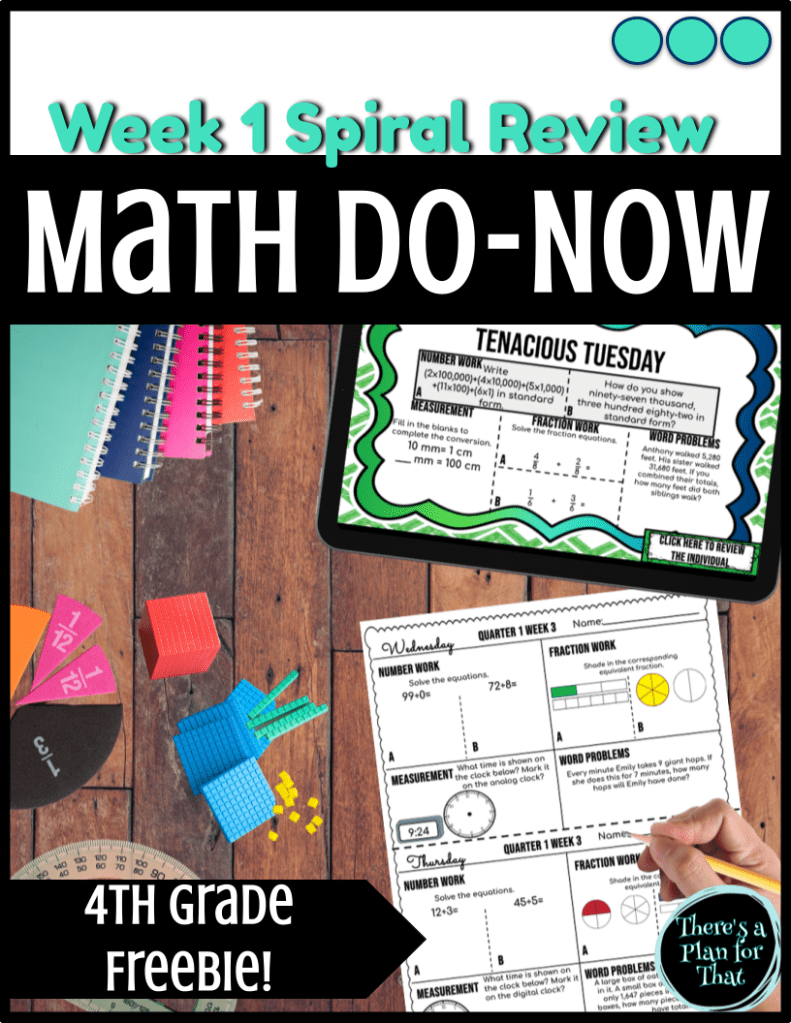
Last week, we discussed how to choose the perfect morning work resource to use with your students. In case you missed it, you can check that post out here. I’ve also created a year-long morning work for Fourth Grade Math. I’m confident that my morning work will check all the boxes for you, so much so that I’m giving away a free sample for you to try it out yourself! If you haven’t already done so, join my email list for your free sample.
Picking the perfect morning work is a significant first step. Today, I want to focus more on best practices to get the most value out of morning work. Ultimately, our morning work is a tool, but we, as teachers, have the responsibility to ensure the tool functions at its full capacity.
When considering adding morning work into your routine, it’s essential to consider your expectations. Why are you adding this in? You’re giving up academic time, so it has to represent more than just a time filler or something you “should be doing.”
From my perspective, I view morning work as the best time to front-load information coming down the line and the perfect time to keep concepts previously taught current and fresh in students’ minds.
I don’t expect all students to get 100% of the questions correct on Monday. If they get that many questions right at the beginning of the week, I would question the rigor of the content. It may be that it isn’t challenging enough, and you may need to look for a different curriculum piece to help grow your scholars.
Because you want some level of challenge associated with answering the questions, you will find, especially in the beginning, that students’ default setting is to ask you for help right off the bat instead of trying to solve the problems themselves.
For this to be truly effective, you have to help your students develop the grit to push through difficult or challenging situations while understanding that you are there to support them throughout the process.
What that looked like in my morning work routine was that I didn’t answer any “how do I solve it” questions during student work time. I would encourage students to give it their best try; I might ask the whole class if anyone could remember a similar question or a page in our math notebooks that might be helpful for us to refer to while solving our morning work to help provide everyone with a hint starting out.
However, I also reviewed the questions from the morning work each morning before moving on to our next activity. Students knew if they didn’t understand the question independently, they would be provided the answers and the reasoning behind the answers before the day moved on.
Depending on how your class morning routine is structured, you may encourage students to ask the people around them for help if they feel stuck on their morning work. I’ve found it beneficial at the beginning of the year not to allow them to talk to peers about morning work because the students tend to get off task very quickly. As the year progresses and they do a better job with routines and procedures, we work our way up to the level where they can be trusted to stay on task, with conversations only about morning work.
To help me have a running record of who was understanding the concepts reviewed, and to make sure students were being held accountable I used a pencil/pen system for morning work.
The expectation was that all students would initially complete their work with a pencil. However, once we started our whole-class review of the problems, they self-corrected/filled in any blank answers with a red pen. They would also give themselves a score at the top of their worksheet (the number of items correct out of the number of items on the paper).
During class review time, pencils could not be visibly out on desks.
Monday-Thursday, these scores were simply for students to see and track their growth throughout the week because the problem types remained similar and built on each other as the week went on. On Friday, I record the student scores for data tracking purposes. I would use the information found through the formative review of the morning work to help guide and shape small group intervention time. It also was good data to have on hand for parent-teacher conferences because it helped allow parents to visibly see their student’s growth throughout the year and how well students could maintain and apply their understanding of skills as the year progressed.
To help ensure student participation, I assigned a completion grade for the morning work for the week; however, it didn’t matter whether it was completed in pencil (their initial attempt) or red pen (the whole class review) as long as the answers were correct and their work was shown.
The important part to me was their work being shown because the answers from Monday were the basis of what I would tell students to look back at if they got stuck on other days of the week because each week had a set of similar problems to review the same standard.
The big takeaway is that effective morning work is reviewed in a timely manner with student involvement so that they are learning from their mistakes and not simply repeating the same mistakes over and over again throughout the week.
Another beneficial change that I made to my morning work routine was to stop calling it morning work. Now, this is more specific for the departmentalized teachers, but when I was teaching three sets of students, my later classes were confused by my ‘morning work’ as they didn’t work on it until the afternoon. Instead, I called it a Do-Now, a term that signifies the mandatory expectation for students to work on it right as they enter the classroom regardless of the time of day.
When you are done with the morning work each week, having the students keep them in a binder creates the ultimate reference point and review guide for the end of the year when testing time rolls around. It also serves as a great student work sample to reference for parent-teacher conferences.
This method not only keeps the students organized but also provides a comprehensive review tool for them and a reference point for you during assessments and conferences.
I fully maintain that morning work was one of the most beneficial things I did during class. It allowed students to engage, review materials, and keep previously taught concepts current. It also provided me, as the teacher, with solid data to inform my small group instruction so that I could easily adjust to meet the needs of my students throughout the year.
Fourth-grade math teachers, remember that I have a free one-week sample of my year-long Do-Now for you to use with your students. So what are you waiting for? Go ahead and join my email list for your exclusive access!

Teachers, I’d love to hear from you in the comments; what are some best practices you’ve found for using morning work in your classroom?

 There's a Plan for That
Leave a comment