

If you know me, you know that I am a huge reader. If you don’t know me let me take a quick second to introduce myself. Hi! I’m Jessi, an avid reader, a former upper elementary teacher, and current elementary teacher content creator, and a mother of a crazy toddler. I’m happy to have you here today, and hopefully, I can give you some great ideas for your classroom library!
In school, I was the type of reader who had several books going at once, to the point where teachers would confiscate my books upon entry into the classroom because they knew I was going to read instead of paying attention. I could easily read a book in a day, sometimes multiple books in a day depending on length.
When I set out to become a teacher, I had dreams of grandeur about this revolutionary classroom library I was going to implement. I planned to inspire my students to have a deep love of reading. I wanted to provide something for every reader, in both interest as well as text complexity. I dreamed of a place with comfortable seating options to choose from and wall-to-wall books. (I know– lofty goals right?)
As I was working through college, I would frequently stop at thrift stores and pick up books for my future classroom. Every time I saw a good deal I snagged it and brought it home! Yard sales, thrift stores, retired teacher giveaways, parents decluttering their kids’ books– you name a way to find books for cheap and I likely had tried it already. This became even worse when my roommate moved out and I had an entire empty bedroom to fill– I could house ALL THE BOOKS. And I did. There was SO. MANY. BOOKS.
I was immensely proud of the books that I had acquired. When I finally got hired for my first teaching job I realized I would be teaching fourth grade. This meant that all of the books I had gathered for the littles (remember I was buying in college for a K-6 degree, so I didn’t discriminate on my book purchasing) needed a home that wasn’t in my classroom. Somehow my bookcase at home became the permanent home for those books for my “future child someday” because who could throw away books, right?
When I was setting up my class library I poured my heart and soul into it. It was easily the part of my room that took the longest time to set up. I enlisted help, I came into the building early in the morning and didn’t leave until after the sun had already gone to bed.
In my head, I would have a library card in the back of each book with a pocket that students could use to “check out” their books. They would write their name and date on it when the book was in their possession and place it inside a pocket chart so I could see at a glance who had books checked out and what book they had at the time.
I also went through and bought cheap dollar tree bins for my books and labeled each of the bins with a sticker or a color, and had a correlated sticker or color attached to the spines of each of the books, to help students remember where to return the books they had gotten.
It was elaborate, it was beautiful. And it was a walking train wreck right from the start. To my first-year teammates who told me I was wasting my time back in the beginning, I guess it’s time to say it now. You were right.
I walked away from that school year feeling like such a failure when it came to my goals and ambitions of a beautiful classroom library. After years to reflect and refine, I’ve come up with some tips and tricks to help you set up your library for success!
Too many book options:
When faced with a wall of options for many children it can be paralyzing rather than exciting. Decision fatigue is a real thing, and in the case of books, less is more. This isn’t to say that you want a classroom library with no books in it, but rather you want to make it so that the book options provided are easy to manage, as well as easy to look through.
We want to provide our students with a variety of choices, but let’s be real, 6 bookshelves in a single classroom is too many books. There ends up being a whole chunk of books that are forever underutilized because there are simply too many options for students to choose from.
This idea of too many book options leads me directly to my next point.
Books are too outdated, or are in too rough of a condition:
This isn’t to say that your library should only consist of modern book options, but one of the pitfalls I found in purchasing so many books at rock bottom prices, is they often were VERY old, and were in haphazard conditions when I first brought them into my classroom.
I found it very difficult to regulate students’ treatment of books during my first year when half of my books were already falling apart. We have to teach students how to handle books with care, and what that looks like when we say it. But that book from the 70s with the yellowing pages… is going to fall apart regardless of how much care students give it. It’s hard to hold students accountable for their treatment of your books when you can’t tell what was bound to happen and what was intentional.
Students also tend to “shop with their eyes” when it comes to picking out books. There are ways you can combat this, and we will talk about some of those ideas later in this post, but it is important to remember that you have to work harder to get the kids to read the books that look “boring” right from the start. If you fill your library with them, they are the ones that are the most likely to be unread by the end of the year.
Utilizing an overly complicated organizational system:
I described the organizational system I put in place in my first year. It was ambitious. Had I been a seasoned teacher I likely could have managed it better than I did. But let’s face it, I spent my first year putting out so many “fires” that handling the books as well as just one thing too many.
This isn’t to say that you can’t have a system, but it can be beneficial to start small.
I would recommend deciding what your philosophy on books is. For example, I want my books to be read. I want my students to learn to love books. What that means is there will be times that baby brother rips pages out of books because I let TJ take the book home. This means that there may be books that a student takes home and never brings back because it was left at their aunties house. (Or maybe they just loved it and kept it, and never plan on confessing.)
I would rather risk the injury and loss of a small number of books, and count on responsibility and the honor system for the bulk of my classroom library survival than limit my students’ access to books to keep them “safe”.
This is a personal philosophy, you may feel differently. It may be more important to you to maintain the quality of the books you have curated in your classroom. And to do so, you may not allow any of your books to leave your classroom doors. Or perhaps you don’t allow students to make use of your library close to break times when books may be home for long periods and more likely to be damaged or forgotten.
There is no right or wrong answer, but knowing your philosophy will help you create a system that makes sense for your classroom.
I had too many books, and too many places for them to be sorted and organized. It was a clunky system that needed too much hand-holding to be efficient.
I would recommend sorting your library by generalized reading levels. For example, I would have 3 labels. A section for my below-grade level books. A section for my on-grade level books. And a section for my above-grade-level books. I would label them with either a color or a shape. And books with that color or shape would belong in that specific section.
I would NOT tell the students that there is a below/on/above grade level section. I would just let the students know that this is how we keep the library organized. The advantage to grouping it by the three categories is it will allow you as a teacher to help guide your students to finding book recommendations that are attainable for their reading levels. You can quickly pull out possible suggestions if need be, and it eliminates some of the wasted time lingering on the bookshelves that students tend to have.
Not creating a system with intentional adult checkpoints:
The goal for your classroom library should be for it to run smoothly. The misconception I had was that I thought it could run smoothly without me having to have personal involvement with its maintenance. For example, I assigned a student the job of librarian… and didn’t swap any other students into that “job” for the entire year. In doing so I learned 2 things. 1. Students don’t want to do the same job for an entire year, and they get tired and slack off on the job. (as adults tend to do as well.) and 2. The idea that the library could run seamlessly without me checking in, and continuing to reinforce the systems I hoped to be in place was laughable. Especially the system I had that had so many moving pieces.
A better idea is to plan a time in your classroom routines when you have specific checkpoints that you review in the library. Over time I found that the time in the morning where we would do a morning meeting was perfect once a week to have our book check-in. Doing it on Fridays, with the incentive of a “fun Friday” element always added some enthusiasm to the check-in. It didn’t have to be long. I would quickly check in with the student “librarian” of the week who had been helping to maintain the shelves. I would also talk about anything I may have noticed during the week that may need improvement, like books being put up with their spines facing inside the shelf, instead of out, or books being found on the floor of the classroom. This is also a time when we could praise the positives that we have noticed in how the library was being used or maintained. The real success point however is the consensus vote. I would have the students vote on this question.
On a scale of 1-5 with 5 being amazing and 1 being very unhappy, how well do you think we did as a class with the library?
I would also vote on the question and have written down my answer on paper before the students voted.
The students can get two points, one point if their number matches my number. And 1 point if the number I had on the paper was a 4 or 5.
The amount of time, or the activity we engaged in for our Friday fun reward time would vary depending on how many points we won if any.
The advantage to voting this way is that it helps force deeper accountability. If the students have had a terrible week and they’re honest about it, then they still get some level of reward time for their honesty, and we’ll make a game plan together for improvement next week. If they have had a great week following the library expectations, they are rewarded. And if they’ve followed expectations, and have been honest with their reflections, they get doubly rewarded.
You can choose what rewards the class gets. It may even be that instead of working towards a Fun Friday time, they’re earning points towards some type of class party. You know what works best for your class and motivating them.
There isn’t enough intentionality in the time dedicated to fostering the love of books:
Lastly, if you want to have a library that helps develop a deep love of books, you have to find ways to expose your students to reading. Your reluctant readers need more hand-holding than just letting them walk around the library and grab a book quickly to satisfy a timer and a student behind them also waiting for a turn to grab books.
I’ve found that for my reluctant readers, it can be helpful to have a spot in your room where high-interest books are showcased. This can be a combination of books that you have chosen to highlight for students as well as books they have enjoyed and would like to highlight themselves.
It can also help to have a variety of different types of books to help draw their interest, not just having different Lexile ranges included but books that are more interest-based like ‘Ripley’s Believe It or Not’, or the ‘Guinness Book of World Records’, where the text is non-fiction, but engaging and concise. More comic books may also be engaging for students less included to pick up books. Do bear in mind that Manga-style books are comic books but often have risque undertones that may not be appropriate for elementary-aged students. Make sure to look through them before blindly placing them on your shelves. Take it from me, that phone call is a whole bundle of awkwardness you’d like to avoid. 🙃
Another thing that I found to be fun to bring some life and excitement into your reading time is to schedule “flashlight” reading times into your week. You can allow the students to bring in flashlights of their own. You could also choose to provide flashlights for students to use. I had to be very economical because shopping for a class set of flashlights can add up fast. I found that purchasing LED tea light candles can be the best way to provide lights for students to use affordably. I picked mine up at the dollar tree, multiple sets of the two packs.

However, you can find them at stores like Walmart and Target as well. At this point, you might even consider checking out apps like TEMU or Wish to see if they could provide the set at a discounted cost.
In summary, your classroom library is an amazing opportunity to foster enthusiasm with your students. Take advantage of this opportunity by developing systems that are manageable, and effective. Less is more when it comes to your books, vote quality over quantity. Don’t forget that you can make it fun, your kids feed off of your energy so let’s make book time a highlight that they anticipate rather than something to drag their feet over.
If you’re interested in some ideas on what books you may want to consider sourcing in your new classroom library, I’ve come up with a list of 50 book ideas that you may look for as the basis for your upper elementary library.
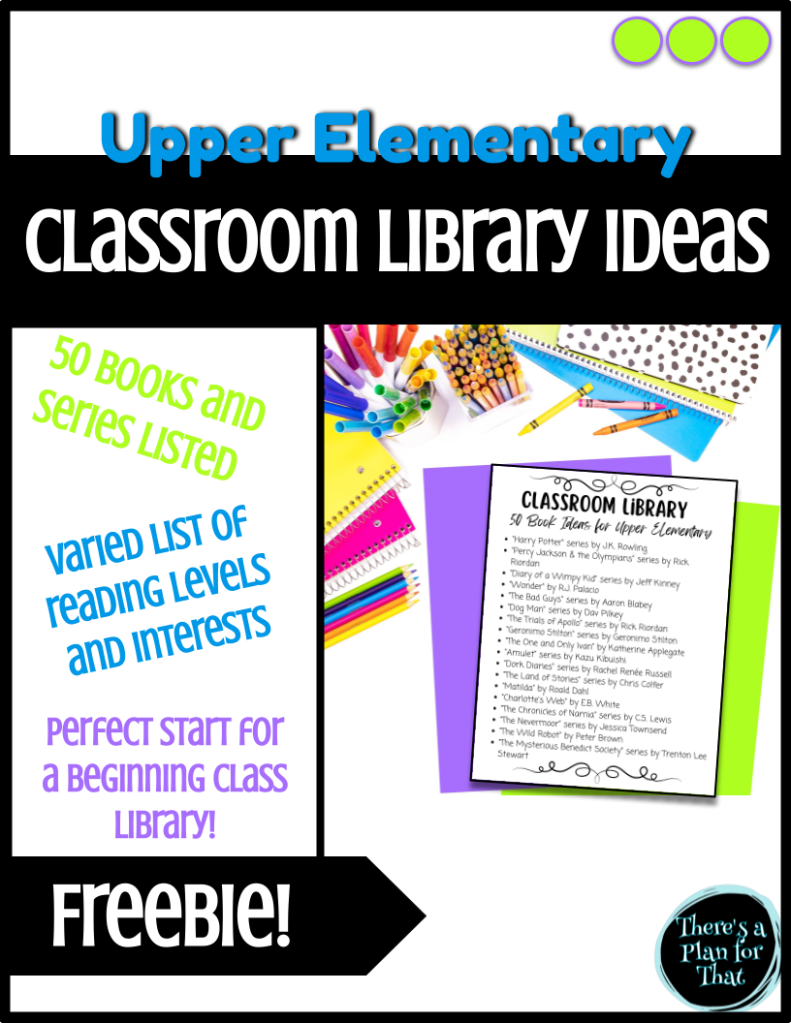
You can find this downloadable list in the Free Resource Library. Click HERE to join my email list and get the passcode information you need to access your freebie today!

 There's a Plan for That
Leave a comment