
Now I know the title says outsourcing, which sounds like you’re trying to pass work you’re supposed to do onto someone else. Which isn’t necessarily the intention or tone of this post, so stick around until I get to the meat and potatoes of this post. What I mean by this title, is that I’ve found in my experience there are TOO many standards that we as teachers are trying to teach and fit into our school year to do them all justice.
Typically our counties will provide us with pacing guides to help make sure we are able to cover all the standards in time during one school year. The problem is, sticking to a pacing guide often means that standards aren’t taught to completion, and then we’re just building a deficit where kids don’t understand the next standards that build on the previous standards, because we moved on too quickly from the first standards.
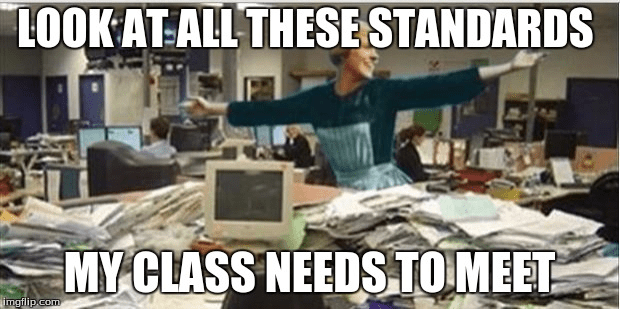
Please don’t misunderstand me, this post also isn’t intended to advise teachers to scrap their pacings, keeping a moving measured pace IS important, because if you don’t then you run out of time at the end of the school year and many standards then become untouched and untaught, which also creates future educational deficits.
So really that is the conundrum, following a pacing too rigidly, or too loosely can be to the detriment of our scholars.
Today I’m here to talk about some preventative measures that we can take to help circumvent some of those pacing issues. Outsourcing our standards to other educators in our kids’ day in ways that make logical sense. Now this will take some creative thinking, as well as discernment as not every standard can be taught by someone besides the classroom teacher.
For example, I know that in 4th grade math symmetry is something that needs to be taught (4.G.A.3.). I also know, if I were to compare the weight and amount of questions a student will potentially see on an End of Grade test between division and symmetry, HANDS-DOWN division would win. If I have to pick one of those two standards to spend my time on, I’d rather give the extra time to some of my bigger standards (I tend to refer to them as high dollar standards) rather than to the smaller concept. But I don’t want to send my scholars off to the next grade having missed out on skills and concepts, so this is where I sit down and think creatively. Symmetry is a skill that could be introduced and PRACTICED in length during an art class. So rather than a quick 1-2 day crash course with a standard, the students could practice it with intentionality in another class.
This can be helpful in several different ways:
1- it helps students see the relevance and importance of what we are learning and how it can apply to other aspects of “real-life” outside of the context of school. If we practice math skills in art, we can see why math might be important to the life of someone who wants to be an artist.
2- our brains are proven to learn and retain information more effectively and thoroughly when we use interdisciplinary methods. Combining the arts, and our academic standards will help solidify and deepen our scholars understanding of what is being taught.
3- it’s fun! Students enjoy innovative and different approaches to learning. Some of the best classroom conversations and discussions I’ve ever gotten have been after lessons where we’ve done something different than just traditional bookwork. Think of your own childhood- you know this to be true.
If you want to read up a little bit more on other potential benefits of integrating our curriculum and the arts feel free to check out this article here.
Now that we’ve established the need, and the what, let’s take a few moments to brainstorm some possible skills and concepts that could be integrated into other areas of our students’ day.
If you have the time, you could print out your list of standards and use that to help guide your brainstorm. You could also look at any pacing guides provided by the county or district you work in. In my experience the standards which are the most likely to fall in the cracks (low dollar standards) are going to be the ones on your pacing that have the least amount of time allotted. I would start by looking at those standards, and see what could be creatively integrated into the students’ days in other ways.
Thinking generally about upper grades math some standards that pop out at me as being sharable are:
Geometry standards.
Specifically angles and line types, shapes, symmetry.
Measurement standards.
Specifically time, conversions, graphing, estimation.
The OA. standards about patterns.
Those are just off the top of my head, looking at your standards, comparing your personal experiences as educators, and your school resources your list may look very different.
Thinking about those standards I listed I know that:
Music class can be a great way to help introduce and review patterns, and fractions! (While it’s not a standard I would ever recommend running out of time to teach, the extra intentional exposure to fractions can be super beneficial!)
Art can be a great place to look at the geometry standards, and patterns.
P.E. Can be a great way to incorporate angles and lines, there are lots of great simon says type moving activities that can be done, or ways to reenact specific lines.
Science can be a great way to incorporate conversions, data graphing, how to use and understand measurement instruments and what their data tells us, estimation!
Even ELA could have some integration. If the class did a poll of themselves about a topic of interest, they could use that information to create their own graphs and write a newspaper article about the data and what it means for the class. This could easily connect to non-fiction standards!
It’s also important that as we consider outsourcing these standards, we also spend time reflecting on our intentionality about our vocabulary. There are so many things that honestly kids need repeated time and exposure to understand, and if we plan our words with INTENTIONALITY we can provide those exposures and opportunities.
For example, when it comes to the idea of angles and degrees, what if we were to use degrees to describe our every-day actions? Instead of saying, “Stand up, and turn around.” What if we chose instead to say, “After we stand up I need everyone to rotate 180 degrees. Can anyone show me what 180 degrees looks like?” or “let’s all turn our heads 90 degrees so that we can go from looking at the board to looking at this poster.”
Telling time is a great concept to be practiced through intentional language.
Teacher: “We’re going to work with our partners today for 5 minutes. Who can look at the clock and tell me what time it is?”
Student: “It’s 8:55.”
Teacher: “Student X saw that the short hand was on the 8 and the long had was on the 11, so she said it’s 8:55. Turn to the person sitting next to you and tell them what time it will be in 5 minutes after we work?”
Students talk for 1-2 minutes.
Teacher: “in 5 minutes the long hand will be on the 12 and the short hand will have moved forward to the 9, meaning we will stop at 9:00. Go ahead and get started.”
In the beginning these conversations may take a little bit of your time, but as they become more routine they also will eat up less instructional time. Students will be able to tell you quickly and easily the more they practice, and get comfortable hearing conversation and language referring to clocks.
Please remember these ideas listed in this post are intended as merely a jumping off point to help you brainstorm some great ways to integrate your standards into other areas of your scholars’ days besides your math block. This is by no means an all inclusive list!
Remember this idea of “outsourcing” your standards doesn’t mean you aren’t teaching them. But it does mean that you are being intentional with your plans and designs on how best to make sure your students get the best exposure and interactions they can with the different standards you need to cover.
One thing that’s nice to remember is that even if you have outsourced standards proactively throughout the year, if you end up having the time in your pacing to cover them, you’re only providing your students with additional practice time, and the ability to have a deeper understanding of the ideas and concepts as they will now be continuing to build on existing knowledge. How awesome is that?
Can you think of any ways you could outsource math standards in your classroom to other subject areas? Feel free to leave them in the comments below, I’d love to read them, and I know that other people would love to see what additional ideas could be generated as well!
Don’t forget there is a free resource library full of goodies waiting for you to access them! Don’t forget to join my email list so you can get your exclusive access to those resources today!

 There's a Plan for That
Leave a comment