
My daughter has been learning how to play on the playground lately. What has interested me, as a parent watching her learn, is how many different skills she has needed to master to be able to “play” on the playground the way I recall playing as a child. She has had to learn how to walk, climb, master stairs, and use the railings for balance. Even the process of going from standing at the top of the slide to sitting with her feet facing the bottom of the slide has felt like a frighteningly slow learning process. Learning how to socialize with other “friends” on the playground has been an entirely new can of worms when it comes to learning what to do. If you know, you know. 😅
As adults, we have learned so many things in our lifetime that we don’t always remember each step of our learning process.
I had a special realization moment when I first taught division to 4th graders. We spent so long learning how to actually divide that, once we mastered the skill of dividing, I was quick to give our end-of-unit test so we could move on to the next unit. Trying to match the mandated pacing is always a struggle, and I was relieved to have finished up division around the time that was allotted to me.

Well, I got the data back for that test, and my students didn’t do well. They failed it so horribly that I actually remember my mentor asking me why I had thought they were ready to move on to the next unit. I was shocked. We had spent so much time learning how to divide, so how could the students not have divided well? But then I looked more closely at the test questions, and here’s what I noticed: Almost all of the word problem questions on the division test included remainders.
I had taught my students about remainders; we knew what they were, and when we divided, the students knew to mark them as “R. ____” at the end of their answer. So, if they were dividing 10 ÷ 3, they would have written their answer as “3 R. 1.” What I hadn’t taught was how to make sense of a remainder in the context of a word problem, which was a big oversight. I honestly thought that interpreting remainders was pretty much a common-sense idea, as I had been doing it for so long that, for me as an adult, it was second nature. I have no memory of explicitly being taught “how” to know what to do with remainders. Therefore, I forgot that we have to provide the kids with more of a framework on how to best approach remainders because what the student does with a remainder can vary drastically from problem to problem.
Today, I’m here to give you the tools to avoid my mistake — to provide your kids with the scaffolding they need to be successful at figuring out what to do with the remainder that they encounter in word problems.
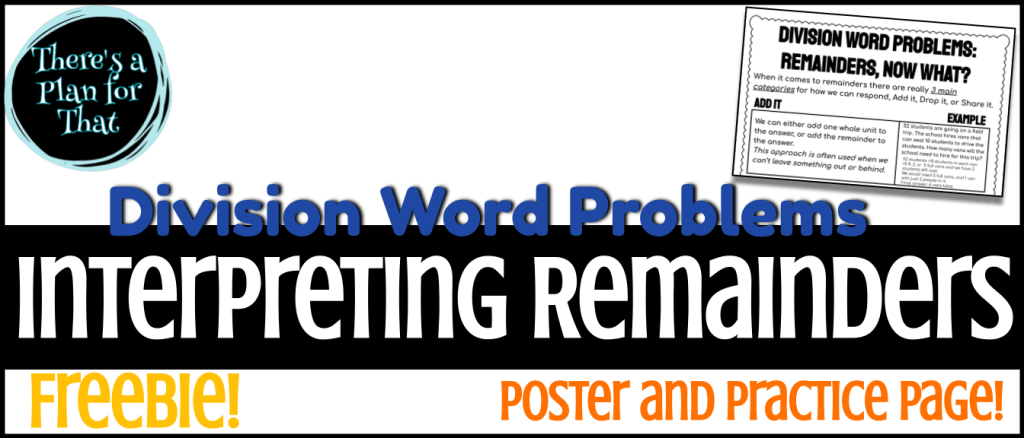
When it comes to remainders, there are really three main categories for how we can respond:
- We can add it: either add one whole unit to the answer or add the remainder to the answer.
- We can drop it, meaning your answer to the problem is either the answer ignoring the remainder or it is just the remainder as your final answer disregarding the whole number.
- Or we can share it, splitting up the remainder into fractional or decimal pieces.
When it comes to figuring out when to do what with the remainders, we have to go to the question in the division problem. What it’s asking us to find will be our guiding star in knowing what to do.
Let’s look at this problem as an example:
52 Fourth Graders are going on a field trip to the zoo. The school hires vans that can seat 10 students to drive the students over to the zoo. How many vans will the school need to hire for this field trip?
Mathematically, this would look like 52 students ÷ 10 students in each van = 5 R. 2.
That means we need 5 vans (with 10 students in each van) and we have 2 students left over.
Now let’s take a closer look at those three approaches to interpreting remainders. I personally like to start with “share it,” as it is the easiest to choose or eliminate depending on the context of the problem.
In this case, we’re talking about “sharing” the two leftover students. That means if we choose this option to find our final answer, we would be talking about cutting those two students into pieces and shoving an arm here, or a leg there into the vans to get those students to fit and go on the field trip.
The idea of that is frankly laughable and illegal. As teachers, we can’t cut up a student to make them fit better somewhere. So that leaves us with two approaches left.
“Add it” or “drop it”.
Next, I like to look at “drop it.” If we dropped the remainder, remember this remainder is actually two students, then we would do a field trip with all the students who properly fit on the vans, and then we would leave two students behind at school for the day. Does that make the most sense? As a teacher, can I just decide, “Oh man, we don’t have enough room, and I don’t really like Tommy all that much today, so even though he paid for the field trip, we’re just going to leave him behind.” No, we can’t.
That leaves us with “add it.” In this case, the best solution would be to drive with 5 full vans and one van that has only two students on it. Yes, the last van isn’t full, but we’re not getting arrested for homicide or getting in trouble with parents for leaving their kids behind.
Our final answer would be 6 vans needed because we take the 5 full vans and add the one partially filled van together to be the 6 total vans.
Let’s look at another example:
Rudy is packing away his books for a trip. He can fit 9 books into each box. If he has 55 books, how many full boxes of books can he fill?
Mathematically, this problem would look like 55 books ÷ 9 books per box = 6 R. 1, or 6 full boxes of books and 1 book not packed yet.
Once again, let’s start with “share it” as the first of the three options for interpreting remainders. If we were going to share the one remaining book between the books in the box, that means we would need to rip that book up into different pieces and shove pieces of that book into each box. What use would it be to us to rip up a book just to pack it along? At that point, we might as well throw it away because we have ruined the book. Therefore, this remainder approach can be eliminated because it doesn’t make sense.
Next, let’s look at “add it.” For a problem like this, realistically, we could add a whole new box and just put the single book in the box, and that would serve as a great solution to the packing problem. However, in this case, the wording of the question helps us eliminate the “add it” option because the question asked how many full boxes of books can he fill. If we added one more box to pack the books, it wouldn’t be full because the box that can hold up to 9 books would only have one book in it. Therefore, “add it” is out.
That leaves us with “drop it.” Because the question asks us how many full boxes were packed, the remainder isn’t relevant to answering the question. Rudy packed 6 full boxes. That’s the whole answer. Is there a box still sitting on the floor next to his full boxes? Yes, but that doesn’t matter when it comes to answering the question that was asked.
Let’s finish off with one more example:
Rebecca and 3 friends bought 6 sandwiches. They plan to eat the sandwiches equally among themselves. How many sandwiches will each girl get?
Mathematically, we would solve the problem as 6 sandwiches ÷ 4 people = 1 R. 2, or 1 sandwich per person and two sandwiches left over.
Starting with “share it,” does it make sense to cut our leftover sandwiches in half to share between the girls? In this case, yes! Unlike example one where “sharing people” involves cutting them apart, or example two where “sharing a book” involves making something that was useful useless, cutting up food is a great way to use this strategy.
Oftentimes, the “share it” strategy is used when we are discussing food, drinks, money, or measurement (like inches, feet, yards). There are some other times that it may be used, but those are few and far between.
Even though we’ve already figured out that “share it” makes sense for this problem, let’s look through the other two options, like we would if we were modeling this strategy in class.
If we picked “drop it,” that means we would be dropping the two leftover sandwiches and not sharing them with the girls at all. It doesn’t make sense to waste food if the problem told us that the sandwiches were shared equally between them.
The last one to check is “add it.” There is no way to add a whole new sandwich for the girls to eat from, nor would adding a whole sandwich fix the problem of there being enough for the girls, even if we could. In example 1, we were in the planning stages, where we needed to figure out how many vans were needed for the kids to go on a field trip. In this problem, we weren’t planning anything; we were told that there was a set amount of sandwiches available. Therefore, this wouldn’t be a valid approach to the remainder either.
To help support you in the classroom when you are introducing this concept to your students, I’ve created a resource in the Free Resource Library that includes a printable poster that can be added to students’ notebooks to help them remember the three different ways we can deal with division remainders, as well as a practice worksheet that you can use when first introducing this idea in the classroom.
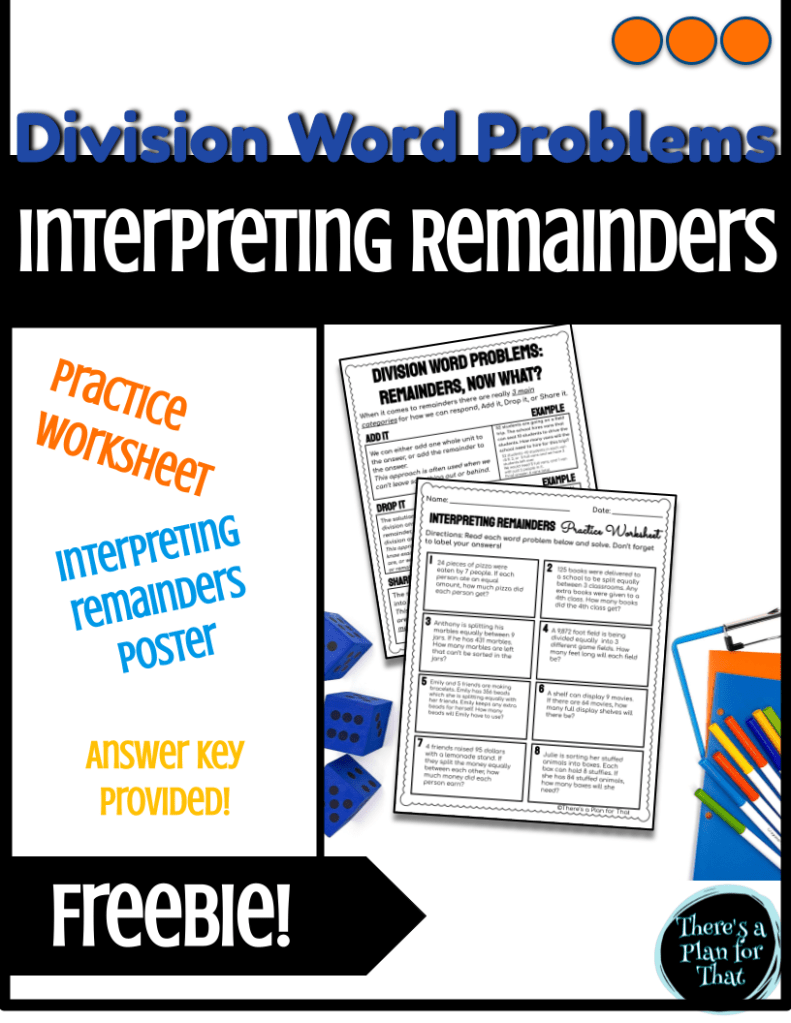
Don’t forget the Free Resource Library is password protected. To get your exclusive access to this freebie as well as many other great resources, make sure you click HERE or the picture below to join my email list. If you’re already on my email list, don’t forget to check your email for the password!

If you’re looking for some additional interpreting remainders practice, I also have a fun division puzzle in my TPT store that you can check out! It includes 8 pages worth of printable puzzles that are great for review, bulletin boards, small group stations, and even substitute teacher activities! Don’t miss out on this great product; go ahead and hop on over and check it out!

 There's a Plan for That
Leave a comment