

In last week’s blog post, I talked a bit about how important it is to review and reestablish classroom behavior expectations before each brain break. Today, we’re going to dive deeper into that idea and why it’s important not just before a brain break but all throughout your day!
I vividly remember my first year of teaching, having a session with my teacher mentor where I was just DUMPING all my frustrations and feelings about the out-of-control behaviors happening in my classroom, and she asked me a question that really caught me off guard. I had just said, “I have really smart kids, they know what to do. They’re just CHOOSING to do the wrong thing.” And she asked, “How do you know?
Of course, at the time, I sputtered and tried to explain how I just knew they wanted to make the wrong choices, etc. But this conversation really stuck with me because it’s easy to feel like because we’ve said something once, our kids should remember and do the right thing every time because they “know” the right thing.
If we aren’t continuing to remind them and review the expectation, then we can’t be sure that they actually understood what the expectation was.
Think about it; the “right choices” to make during a math lesson are going to look completely different than the “right choices” to make during a transition like end-of-the-day packing up to go home. Our scholars still need our guidance and support to help them remember what the expectations are so they can make the right choices throughout the day.
This is where C.H.A.M.P.S. comes into play. C.H.A.M.P.S. is an acronym that originates from Randy Sprick, Ph.D. He introduces this concept in his book, “CHAMPs: A Proactive and Positive Approach to Classroom Management.” C.H.A.M.P.S. stands for conversation, help, activity, movement, participation, and success.
The key to C.H.A.M.P.S. success is that every time there is a transition or a change in behavior expectations, the teacher goes through each of the different letters and “champs out” the expectations for the new change. In the beginning, it does take a little more time to establish your expectations, but as the school year progresses, this becomes an ingrained habit and happens quickly, so don’t stress about it eating up the already limited time that we have!
(Stay tuned until the end; there is a C.H.A.M.P.S. Freebie included!) Now let’s break down the different letters and what they actually mean.
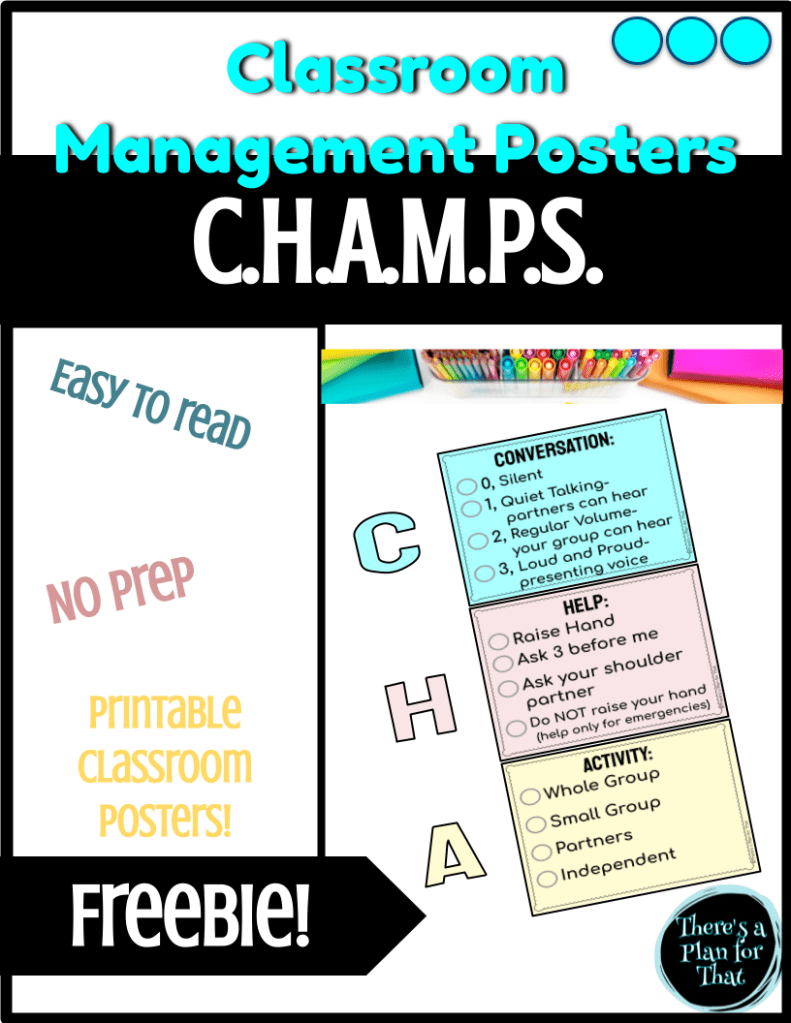
Conversation: This is specifically focused on the volume level you are expecting during the activity that is going on in the classroom. If it’s independent work, you would likely be going for silent (voice volume 0) or quiet/whisper talking to the people around them, which would be voice volume 1. If your scholars are working in a group setting, you’d likely want them to be on a voice volume of 2, which is louder than just the person next to them being able to hear but not so loud that a group across the room should be able to listen in. And lastly, there is voice volume 3, your loud and proud presenting voice, which would be used when sharing something for the entire class to hear. There is typically a volume 4 as well, which is an outdoor voice, but for the sake of managing indoor classroom expectations, you would be unlikely to expect yelling and screaming as it would likely disturb the learning taking place in other spaces around your classroom.
Help: This one is important because your students need to know how to get questions answered. Should they be raising their hand and waiting to be called on? Should they be walking up to the teacher and asking a question? What about asking people around them a question about their work or what to do, is that acceptable? We’ve all been there in the middle of our lesson when we’re trying to give directions, and we can’t even make it through the directions because of the frantically waving hand that is asking a question, which you were ALREADY intending to answer in your directions. It’s fair to say right now we’re not taking questions or asking for help unless it’s an emergency, and the ‘Help’ portion of C.H.A.M.P.S. is the avenue to set that expectation.
Activity: I’ve found that this part is especially nice for students who may be entering the classroom in the middle of a lesson. A student walking in can immediately see what type of activity is going on and can more easily jump into what they need to be doing. It helps students to feel less stressed when reentering a classroom. It also allows for any visitors walking into your room to see right away what the classroom expectation is for what the kids are working on. Typically, activity types are classified into categories such as whole-group lessons, small-group activities, partner activities, and independent work.
Movement: When working with kids, establishing explicit parameters regarding movement BEFORE they are actually moving dramatically cuts down on classroom management interruptions. It helps to eliminate the running and pushing while trying to line up; it can stop partners who are working around the room from inching all across the carpet until they have formed one big off-task huddle. It helps keep kids safe from being stepped on or bumped into, and as a teacher, it allows you to feel more in control of all the moving pieces in your room. Establishing movement expectations is also great for quick redirections. If you have reviewed that the expectation is that all students are staying in their seats for this lesson, and Johnny is standing up and trying to walk across the room to give his buddy something, then you can quickly say, “Johnny, check out our C.H.A.M.P.S., what is our movement supposed to be right now?” and rather than engaging in a battle of will regarding what Johnny was doing and why, it can be a quick conversation of reminding him what the expectation is and giving him the chance to reset himself. Some categories that we might see under movement include remain seated, staying in one place (this would be more like if students were working in pairs around the room, but once they were in a spot they couldn’t continue to move around), moving as directed (think games, brain breaks, or lesson activities), or transitioning to a new place.
Participation: This helps your scholars to know what is expected of them to demonstrate that they are remaining on task. Sometimes participation requires tracking the speaker with their eyes, bodies, and ears. Other times participation may look like reading/writing on a paper or worksheet. Engaging in polite and respectful conversations is a form of participation, as well as taking notes while listening. When we tell the kids what we expect, then we can quickly address moments when they are distracted or off task. For example, if we’ve already reviewed that right now is a time for listening and taking notes, and a student doesn’t have a notebook and pencil, then we can quickly see that they are off task and not meeting the expectations that have been set.
The final and easiest category of our champs is the S for Success! If we C.H.A.M.P. it out and follow all of our steps, then we will have achieved success!
Having a poster that is easily accessible and editable is key to making this classroom management strategy a success. I’ve found that I’ve had the best luck when it was posted in the very front of my room on the whiteboard. It is possible to write out all of the elements, but that always seemed to eat up too much of my time. My favorite way to use C.H.A.M.P.S. was to have laminated posters attached to the whiteboard and either magnets or a clothespin to move, which indicated what the expectation is in the room at any given time. You can even decorate your magnets or clothespins to help tie them into the theme of your classroom decor, which will help everything feel more tied together.
It is important to note that, as with ANY classroom management system that you try and implement, the key is consistency. If you try this for one week and then don’t use it again, it’s not going to work. If you only use your C.H.A.M.P.S. half of the time and other times of your day just ignore it, then the kids won’t be able to trust the information displayed on the board is accurate, and will just err on the side of it not being relevant to them, and they don’t need to follow it.
Since this classroom management system is designed to be reinforced with a visual reminder for all expectations, I’ve created a FREEBIE available especially for my readers. You can find it in my free resource library that you can print and display to start using C.H.A.M.P.S. in your classroom today!
P.S. The free resource library is password protected, join my email list for your access to the password! Click the HERE or the box below to join my email list!

 There's a Plan for That
Leave a comment